Traveling can be riddled with unexpected snafus.
As a full-time wheelchair user, Kristy Durso knows this well. What some simply see as an inconvenience — a heavy door, a tight airplane lavatory, or even the awkward placement of shower controls in a hotel bathroom — could pose a safety risk for her and other individuals with limited mobility.
In fact, when Durso, the owner of Incredible Memories Travel, is on the road, she’s always scanning her surroundings, taking note of any obstacles that may ruin a future trip for a client with accessibility needs.
“Imagine if you got to a hotel room, and you are not able to get into the bed because it’s at chin height,” she said. “High beds are very fashionable, but a super-high bed means we can’t get in it. Or, imagine that your shower had a lock on it, and the only way to get into that shower is if you call down to the staff and ask them to bring you the key. In reality, that’s the kind of thing that happens to us.”
The Americans with Disabilities Act (ADA), signed into law in 1990, put federal protections in place to help Americans living with disabilities navigate many areas of public life.
And while Durso says she believes the ADA was created in good faith — and was even considered cutting-edge at the time — she believes it now places greater emphasis on basic compliance than true function.
“[The ADA] was a great start to building accessibility,” she said. “Nobody had ever done anything like it, and we had lots of champions — people who had disabilities — who were involved in creating that [law] and bringing it about. What has happened since is that we’ve kind of lost our way. We’re missing the whole human component. The focus is on being compliant to the law, and not actually considering, ‘Why does this matter?’”
It’s an issue that inspired entrepreneur Jake Steinman to create TravelAbility, an organization with a mission to improve the travel experience for people with disabilities through events, newsletters, resources and education.
“I’ve found that the travel industry consists of three mindsets: One is a mindset of fear … of getting complaints and getting sued, so, for them, it’s all about compliance at a baseline level. Another mindset is one of idealism — these are the people who feel it is unfair to not be inclusive for everyone, and so they become hyper-accessible,” he said, noting that museums and certain attractions, such as theme parks, often fall into this camp. “And the third mindset was the one I had, which is that this is a growing market — the demographics are in favor of it — and people are going to age into a disability, if they’re lucky. So, we’re creating programs to fill the gaps.”
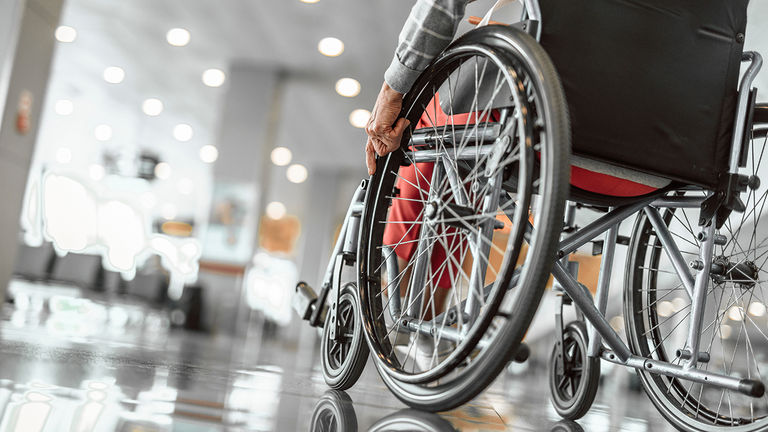 Mobility limitations affect 14% of adults living with a disability.
Credit: 2023 Yakobchuk Olena/stock.adobe.comDisabilities on a Spectrum
More than a quarter of American adults (26%) live with some form of disability. The Centers for Disease Control & Prevention offers insight into into six functional disability types: mobility disabilities (which include 14% of U.S. adults with a disability); followed by cognition disabilities (at 11%); independent living disabilities (which references the difficulty one has in running errands and otherwise providing for themselves alone, 7%); hearing disabilities (6%); vision disabilities (5%); and self-care disabilities (categorized by the difficulty in dressing or bathing oneself, 4%).
The wide-ranging community is what disability expert and author Kathie Snow calls “the nation’s largest minority group, which is simultaneously the most inclusive and the most diverse.”
“Everyone’s represented — people of both genders and of all ages, as well as individuals from all religions, ethnic backgrounds and socioeconomic levels,” she wrote in a 2005 essay. “Furthermore, the disability community is the only minority group which anyone can join, at any time.”
It’s also a group that has big bucks to spend on travel: Of the 61 million adults in the U.S. who identify as living with a disability, 27 million of these travelers took a total of 81 million trips from 2018-2019, spending $58.7 billion on just their own travel, according to disability nonprofit Open Doors Organization.
 Between 2018-2019, travelers with disabilities spent $58.7 billion.
Credit: 2023 Osato-Kurita-Circus/stock.adobe.comPlanning Travel: Not a One-Size-Fits-All Approach
Considering the size of the market, travel advisors have a prime opportunity to mitigate potential stressors for this group.
And the hunger to learn more about selling this type of travel is certainly there: A survey last month of more than 250 agents, part of TravelAge West’s Need to Know research series, revealed that 63% of respondents are already selling travel to clients with accessibility needs. However, 79% want to learn more about it, and 80% of those surveyed believe that more education on the topic would help their businesses.
And there are many potential clients who might be “staying home instead of using a travel advisor,” said Dawn Barclay, author of “Traveling Different: Vacation Strategies for Parents of the Anxious, the Inflexible, and the Neurodiverse.” (Her book, it should be noted, addresses the travel challenges faced by families with both neurotypical and neurodivergent members, the latter of which may include non-visible disabilities — also called “hidden” or “invisible” disabilities — such as autism spectrum, attention and/or mood disorders.)
For parents of children with neurodivergent disabilities specifically, “the biggest misconception is that they don’t believe they are entitled to travel, or that there won’t be venues that will understand and accept them,” Barclay said.
Durso of Incredible Memories Travel describes this as a circular problem: People with disabilities know their needs are not going to be met at certain businesses, so they don’t venture out to patronize them. That place, in response, doesn’t actively see the disability community represented in its clientele, and doesn’t feel an urgency to fix any existing problems.
Global research backs this up: A recent report about inclusivity from Expedia Group Media Solutions shows that only 54% of the 11,000 consumers surveyed worldwide believe they have seen options that are accessible to all abilities when booking a trip (even when 92% of respondents believe it’s important for travel providers to meet the needs of all travelers).
 Only 54% of travelers say they have seen fully accessible trip options.
Credit: 2023 janckerphoto/stock.adobe.comWhat to Keep in Mind During the Trip-Planning Process
Receiving proper education is critical for agents before they jump in and begin booking travel for this group, Barclay says, noting that travel advisors working with clients with autism should look into credentials with the International Board of Credentialing and Continuing Education Standards (IBCCES).
“In a survey by IBCCES, in 2018, 87% of special-needs parents said they don’t travel, but 93% said they would if they knew where to go and what to do,” Barclay said. “When the survey was updated in 2022, those numbers changed to 78% who wouldn’t travel (a 9% improvement) with 94% willing to travel if they knew where to go and what to do. Meredith Tekin, president of IBCCES, attributed the improvement to the proliferation of credentialing programs in the market now.”
Then, once advisors feel well-equipped and ready to work with clients, “it’s very important to be respectful, but direct, when speaking with [them],” said Jessica Riediger, an accessible travel specialist at Vincent Vacations.
It’s possible, with a little extra work, for clients of all abilities and differences to travel.
“You’re going to need to ask lots of questions,” she said. “[For clients with mobility issues, this] includes the dimensions of their wheelchair/scooter, and sometimes you will need to know the client’s height and weight, items they may need in the restroom and more. There are a lot of moving pieces that need to be addressed to be sure a client is well-cared for from start to finish.”
At Incredible Memories Travel, Durso has created a comprehensive pre-consultation questionnaire for her clients.
“Everybody requires different things,” Durso said. “The questionnaire has several questions on it to make sure I’m getting the information that I need, and it took me 3 ½ years to get this correct. It’s so easy to miss if you’re not living it, until you start talking to people living it. So, I ask, ‘Could you go ahead and fill this out for me so I can get an accurate assessment of what you need?’”
Everybody requires different things ... It’s so easy to miss if you’re not living it, until you start talking to people living it.
After she receives the answers, Durso begins calling supplier partners, requesting photos and measurements, especially when it comes to hotel rooms and cruise cabins. And when it’s time to book flights, she calls airlines to secure seat assignments (a complimentary service for passengers with disabilities, thanks to the Air Carrier Act), and puts in a request with the TSA Cares helpline, which sends a trained TSA agent to aid clients through the pre-flight screening process and airport experience. (Another tactic that Durso uses includes placing a family in two consecutive airplane rows on the same side of the plane, with a neurodivergent individual next to a window and behind another family member to create a more secure, comfortable flying experience for them.)
Travel advisors must also make sure clients are prepared for potential disruptions that may arise in-destination.
 Individuals with disabilities are the largest underserved minority in the U.S.
Credit: 2023 Avelino/stock.adobe.com“Things go wrong for travelers without disabilities, and things can go very wrong for people with disabilities,” Durso said. “So, I say, ‘If you have a problem, try to address it. And if you can’t fix it, or they don’t fix it, call me when it’s happening. Don’t wait until it’s finished.’”
For clients with cognitive disabilities, Barclay recommends that advisors ask about environmental triggers.
“For example, if you have a client with a child with autism, and that child hates being crowded and encountering strange smells, perhaps you don’t want to put them on the free bus transfer that the hotel offers from the airport, when a private car, taxi or rideshare might offer more space and privacy,” she said.
“It’s possible, with a little extra work, for clients of all abilities and differences to travel,” added Riediger of Vincent Vacations. “It’s rewarding to receive pictures of clients in destinations they only dreamed of going — castles in Europe, the streets of France, the beaches of Mexico — that you made possible for them.”
A Travel Advisor Playbook
To help travel providers make their businesses as accessible as possible to a wide range of clients, Steinman and his team at TravelAbility spent seven months developing the 2022 Accessibility Playbook, a 37-page document created for members of the travel industry. The playbook goes over ways travel businesses can transition their marketing materials, website landing pages and more to be as accessible as possible. Here are a few highlights:
Use Person-First and Language When Communicating With Clients: Because the disability community is not a homogenous group, it’s important to ask clients how they prefer to be described. Person-first language places the emphasis on the person, not their disability, and focuses on their abilities rather than their limitations (ex: “people with disabilities,” vs. “the disabled,” or “Person who uses a wheelchair” not “wheelchair bound”).
Design an Accessible Travel Website and Offer an Accessible Landing Page: When designing a business website, consider how each feature could be used by people living with disabilities. This may include using an inclusive color scheme (and avoiding color combinations that may confuse those with color blindness); providing forms that can be accessed without a mouse; and alt-tagging images and tables (which helps users identify the image via text or with a screen reader). You should also provide accessible travel information prominently via an Accessible Landing Page, which displays accessibility travel information and links directly to the accessibility page of your supplier partners.
Survey Your Suppliers: Send out a survey to potential supplier partners, which may include questions such as, “Do you have a dedicated and detailed accessibility page on your website?” “Are your staff trained on guest evacuation requirements in case of emergency?” or “Does your [venue] offer “quiet spaces” for guests who are hearing impaired or who have cognitive disabilities?” among others.
Be Inclusive in Your Marketing: According to Expedia, 78% of consumers have made a travel choice based on promotions and advertisements that they felt have represented them through messaging or visuals, yet only 1% of travel marketing is, in fact, representative. Agents should include images of people with disabilities in their marketing materials, tell people about their accessibility features in the same places they promote your services; have a dedicated staff to support clients with accessibility needs; and consider offering multiple formats for interpretative materials, such as print, audio and subtitled video.
